HR teams know the feeling: A job description is due by noon, onboarding emails need a personal touch, and a performance review summary is still waiting to be written. The work requires your judgment, but the first draft doesn’t always need to start from a blank page. With the right ChatGPT prompts for HR, you can move faster on everyday writing tasks like job descriptions, policy updates, and onboarding emails—and give yourself more time to focus on the decisions and conversations that need a human perspective.
AI is already becoming part of everyday HR work. Almost a third of HR leaders use generative AI somewhere in hiring, and 27 percent of people use AI tools regularly in the workplace.
This guide brings together practical ChatGPT prompts for HR across recruiting, onboarding, performance, engagement, policy, learning, and any other letters nobody wants to write from scratch. Use them to draft, summarize, and refine everyday HR content while keeping people in control of the final decisions. Pair them with a platform built for generative AI in HR, and ChatGPT can become a practical part of the flow of work.
Key insights
- ChatGPT prompts give HR teams a fast first draft for writing-heavy work like job descriptions, onboarding plans, and policy documents, in a repeatable structure that stays consistent from one draft to the next
- The best HR prompts include specific context, a defined output format, and clear tone guidance
- AI supports HR decisions, but hiring, employee relations, and compliance still call for human judgment
- HR teams that combine AI tools with a modern HR platform move faster without losing the personal touch people expect
Why HR teams are turning to AI prompts
AI prompts help you get the most out of ChatGPT as a fast first-draft machine for writing-heavy work. It’s one of the most practical ways AI can help HR practices right now, and a step toward tools that act on their own, like AI agents. A few benefits of AI in HR are:
- Speed: A good prompt turns a blank page into a working draft in minutes, whether that’s a job description or a performance review summary.
- Consistency: Prompts and task-specific GPTs create a repeatable structure for onboarding plans, engagement surveys, and policy updates.
- Capacity: Every draft you don’t start from scratch buys back time for coaching, workforce planning, and the conversations only a person can have.
- Range: The same prompt structure works outside the HR team. Finance partners use it to draft headcount and budget forecasting assumptions, and managers use it for review notes and team updates, so what people read stays consistent across the employee lifecycle
Every prompt below works in ChatGPT. It only knows what you give it, but you don’t have to give it everything every time. If you’ve built a custom GPT, set up a project, or uploaded your own files, it can already pull your company specifics from there. If you haven’t, paste or attach them with the prompt: your tools stack, your benefits list, who the new joiner meets on day one. Either way, the bracketed inputs below are the part that turns a generic draft into one you can send.
A warning worth highlighting: AI writes confidently even when it’s wrong. Every draft needs a human review, and nothing involving compensation, discipline, or personal data belongs in a public AI tool. See how to implement AI responsibly in HR for the guardrails worth prioritizing.
<< Download the free ChatGPT prompts for HR template >>
ChatGPT prompts for recruiting and hiring
Recruiters use ChatGPT to draft job posts, generate interview questions, and summarize candidate notes. Any prompt touching candidate evaluation needs a human reviewer, since AI can carry bias forward from its training data.
Skip: “List 7 steps HR should follow when creating a recruitment strategy.”
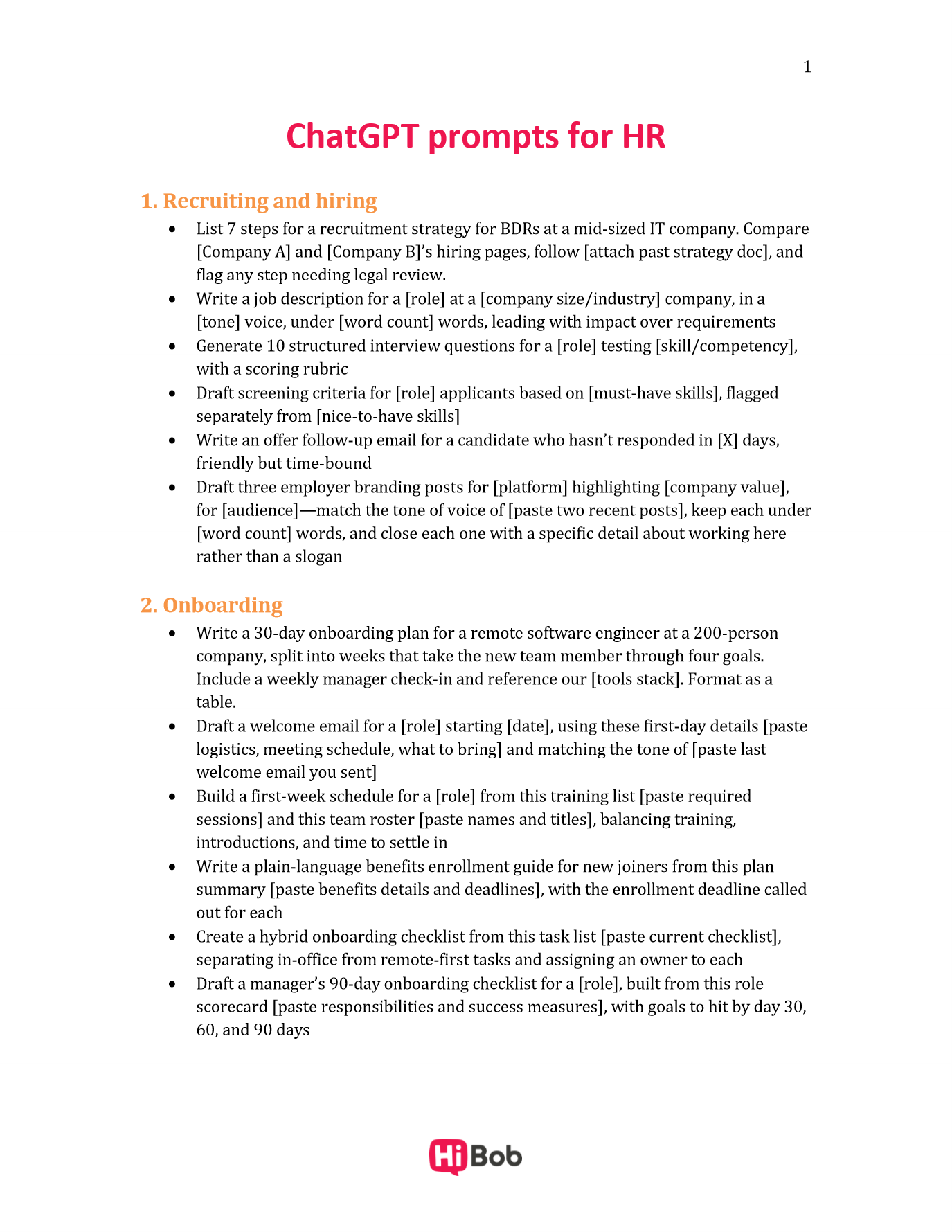
Try: “List 7 steps for a recruitment strategy for BDRs at a mid-sized IT company. Compare [Company A] and [Company B]’s hiring pages, follow [attach past strategy doc], and flag any step needing legal review.”
More prompts to copy and adapt for your needs:
- Write a job description for a [role] at a [company size/industry] company, in a [tone] voice, under [word count] words, leading with impact over requirements
- Generate 10 structured interview questions for a [role] testing [skill/competency], with a scoring rubric
- Draft screening criteria for [role] applicants based on [must-have skills], flagged separately from [nice-to-have skills]
- Write an offer follow-up email for a candidate who hasn’t responded in [X] days, friendly but time-bound
- Draft three employer branding posts for [platform] highlighting [company value], for [audience]—match the tone of voice of [paste two recent posts], keep each under [word count] words, and close each one with a specific detail about working here rather than a slogan
ChatGPT prompts for onboarding
HR teams use ChatGPT to turn one simple onboarding template into a detailed plan that fits each role, whether it’s remote, hybrid, or on-site.
Skip: “Write an onboarding plan for a new employee.”
Try: “Write a 30-day onboarding plan for a remote software engineer at a 200-person company, split into weeks that take the new team member through four goals. Include a weekly manager check-in and reference our [tools stack]. Format as a table.”
More prompts to build from:
- Draft a welcome email for a [role] starting [date], using these first-day details [paste logistics, meeting schedule, what to bring] and matching the tone of [paste last welcome email you sent]
- Build a first-week schedule for a [role] from this training list [paste required sessions] and this team roster [paste names and titles], balancing training, introductions, and time to settle in
- Write a plain-language benefits enrollment guide for new joiners from this plan summary [paste benefits details and deadlines], with the enrollment deadline called out for each
- Create a hybrid onboarding checklist from this task list [paste current checklist], separating in-office from remote-first tasks and assigning an owner to each
- Draft a manager’s 90-day onboarding checklist for a [role], built from this role scorecard [paste responsibilities and success measures], with goals to hit by day 30, 60, and 90 days
Pair these with a new hire checklist or a 30-60-90 day plan for more effective onboarding processes.
ChatGPT prompts for performance management
Performance management is where AI can turn raw feedback into structured documents in minutes.
Skip: “Write a performance review summary.”
Try: “Summarize this feedback [paste notes] into a review summary for a [role] at [level], organized by strengths, growth areas, and one goal for next quarter. Be direct but constructive, under 300 words.”
More prompts for the cycle:
- Generate 10 360-degree feedback questions for a [role], covering collaboration, communication, and delivery
- Build a goal-setting template using the [SMART/OKR] framework for a [team/role], with manager and self-rating fields
- Draft a performance improvement plan for [role] addressing [specific gap], with 30/60/90-day milestones and success criteria
- Write quarterly OKRs for [team] aligned to [goal], with three to four measurable key results each
- Draft a skills gap analysis for [team] comparing [current skills] against [skills needed for upcoming projects]
Start from a performance improvement plan template or employee goal-setting template so the draft already matches a format you use.
ChatGPT prompts for engagement and retention
Culture and engagement matter more than most retention plans admit: A toxic culture is 10 times more predictive of attrition than compensation. AI helps HR teams quickly turn engagement survey comments into patterns worth acting on to increase retention. It can also help teams brainstorm those survey questions quickly.
Skip: “Analyze our engagement survey results.”
Try: “Analyze these survey results [paste data] and identify the top three themes by department, flag scores that dropped more than 10 percent since last quarter, and suggest one action per theme.”
More prompts worth trying:
- Draft five pulse survey questions to check team sentiment after [recent change, e.g., a reorg]
- Brainstorm 10 recognition program ideas for a [remote/hybrid/in-office] team with a budget of [amount]
- Summarize open-text survey comments [paste comments] into three themes, with a representative quote for each
- Draft a retention strategy outline for [department] with high turnover, based on [exit interview themes]
ChatGPT prompts for HR policy and compliance
Policy writing eats hours that could go toward the part of compliance that needs a human: judgment calls. ChatGPT speeds up the drafting, and humans provide the essential touch in the nuance of human connection.
Skip: “Write a remote work policy.”
Try: “Draft a remote work policy for team members across [states/countries], covering eligibility, equipment, hours, and data security. Match the tone of [attach existing policy] and flag sections needing local legal review.”
Prompts to adapt:
- Simplify this policy document [paste policy] into plain language, keeping every legal requirement intact
- Draft a compliance FAQ for [topic, e.g., overtime rules] answering the eight questions people ask most
- Write an internal announcement explaining a policy change, including why and when it takes effect
- Draft an [AI adoption/acceptable use] policy outline for a [company size] company, covering approved tools and data handling
ChatGPT prompts for learning and development
Learning and development (L&D) teams can use ChatGPT to turn a skills gap into a training plan without starting from a blank curriculum. The investment pays off in retention: LinkedIn’s 2025 Workplace Learning Report found career progress is the top reason people choose to learn, and 91 percent of L&D professionals say continuous learning matters more than ever for career success.
Skip: “Create a training plan.”
Try: “Create a training needs analysis and plan for [team] based on these skill gaps [list gaps] and upcoming projects [list projects]. Rank by urgency and suggest one format (workshop, course, mentorship) each.”
More to try:
- Draft a course outline for [topic] training, aimed at [audience level/background], deliverable in [format, e.g., three sessions]
- Design a mentorship program structure for [department]: matching criteria, meeting cadence, and a six-month check-in plan
- Build a skills assessment framework for [role], scoring each skill from beginner to expert with example criteria
ChatGPT prompts for other HR letters and documents
AI can be useful when HR needs to write on a deadline. Pair each prompt with a template, like review preparation letters, performance notifications, and offer letters, so you can move quickly from draft to finished document.
- Draft an offer letter for a [role] at [salary/level], reporting to [manager title], starting [date], with a [X]-day response deadline. Pull compensation details from [paste comp summary], match the tone of [attach a recent offer letter], and keep every legal clause exactly as written in this offer letter template.
- Write a reference letter for a former [role] who worked with me for [length of time]. Use these specifics [paste two or three achievements with numbers], address it to [recipient], keep it warm but professional and under 300 words, and follow the structure of this reference letter template.
- Draft a written warning for a [role] about [performance/conduct issue], using this record [paste dates, what happened, and any prior conversations]. State the expectation, the improvement window, and the next step if nothing changes. Neutral and factual, with no characterizations of the person. Match this written warning template and flag any section needing legal review.
Every letter still needs a human check on names, dates, figures, and other details AI might round off or invent.
<< Download all 30+ prompts in one editable template, ready to copy into ChatGPT >>
How to make a good AI prompt for HR
Every prompt above follows the same structure, built from four pieces: role and context, output format, tone and audience, and constraints (word count, required sections, compliance language). Consider the following example as you begin working on your own prompt:
Before: “Write a job description for a sales manager.”
After: “Write a job description for a sales manager at a 150-person SaaS company, reporting to the VP of Sales. Lead with the team’s mission, list five responsibilities and four requirements, under 350 words, direct and no-jargon, aimed at experienced reps.”
The second version leaves ChatGPT less room to guess. Ask for a shorter version, a warmer tone, or a forgotten section. Add company-specific details, give it sample sources to learn from, and treat the output as a first draft that still needs your platform’s real data behind it, like the workforce management data in your HRIS.
Recommended For Further Reading
What AI can’t do for HR (when to keep it human)
ChatGPT drafts faster than individuals, but human-focused tasks and verification of details generated by AI reside with humans in all cases. Here are a few examples of what AI can’t tackle:
- Final hiring decisions, which need judgment about role and culture fit no model can weigh
- Sensitive team member relations conversations, where tone and timing matter more than wording
- Disciplinary actions, which carry legal weight and need an accountable person
- Legal compliance sign-off, since AI can’t be held responsible for getting it wrong
- Confidential people data, which never belongs in a public AI tool
AI-generated content can carry forward the bias in its training data without flagging it, so any output touching people decisions needs a second look.
Building trust in AI starts with treating it as a friendly, transparent tool. Used this way, prompts free up time for the parts of the job that are actually about working with people.
<< Download the full list of 30+ prompts, and start with the section eating the most of your week >>
ChatGPT prompts for HR FAQs
What are the best ChatGPT prompts for recruiting?
The job description generator, interview question builder, and screening criteria prompt above save the most drafting time. Any prompt touching candidate evaluation still needs a human reviewer, since AI can carry bias into any draft without flagging it.
Is it safe to use AI for HR tasks?
It’s safe for drafting, but it can be risky for data without specific guardrails and human review processes. Public AI tools can retain what you type, so names, salaries, and performance details shouldn’t go into a prompt. Enterprise AI tools built with HR data governance, like the ones inside an HRIS, handle sensitive data with more control.
How do you write better AI prompts for HR?
Give ChatGPT the role, the format you want back, the tone and audience, and any constraints. Then request edits: Ask for a shorter version, a warmer tone, or a missing section.
Can ChatGPT replace HR professionals?
No, AI can’t replace HR professionals. ChatGPT handles the repetitive writing that used to take up an afternoon, but it can’t build trust with a nervous new hire, mediate a conflict between co-workers, or make the experienced judgment call a termination requires.