Net income is the profit a company earns after covering all of its business expenses, including taxes and deductions.
Net income is one of the clearest indicators of a company’s overall profitability, showing how much value the business has created for its shareholders during a given period. You’ll find it at the very bottom of the income statement, which is why it’s often referred to as the “bottom line.”
For Finance teams, net income is a useful measure of overall business performance, but understanding what sits behind the number matters just as much. In this guide, we’ll explain how net income works, how to calculate it, what affects it, and how to use it alongside other financial metrics to get a clearer view of company performance.
<<Download the SaaS metrics cheat sheet.>>
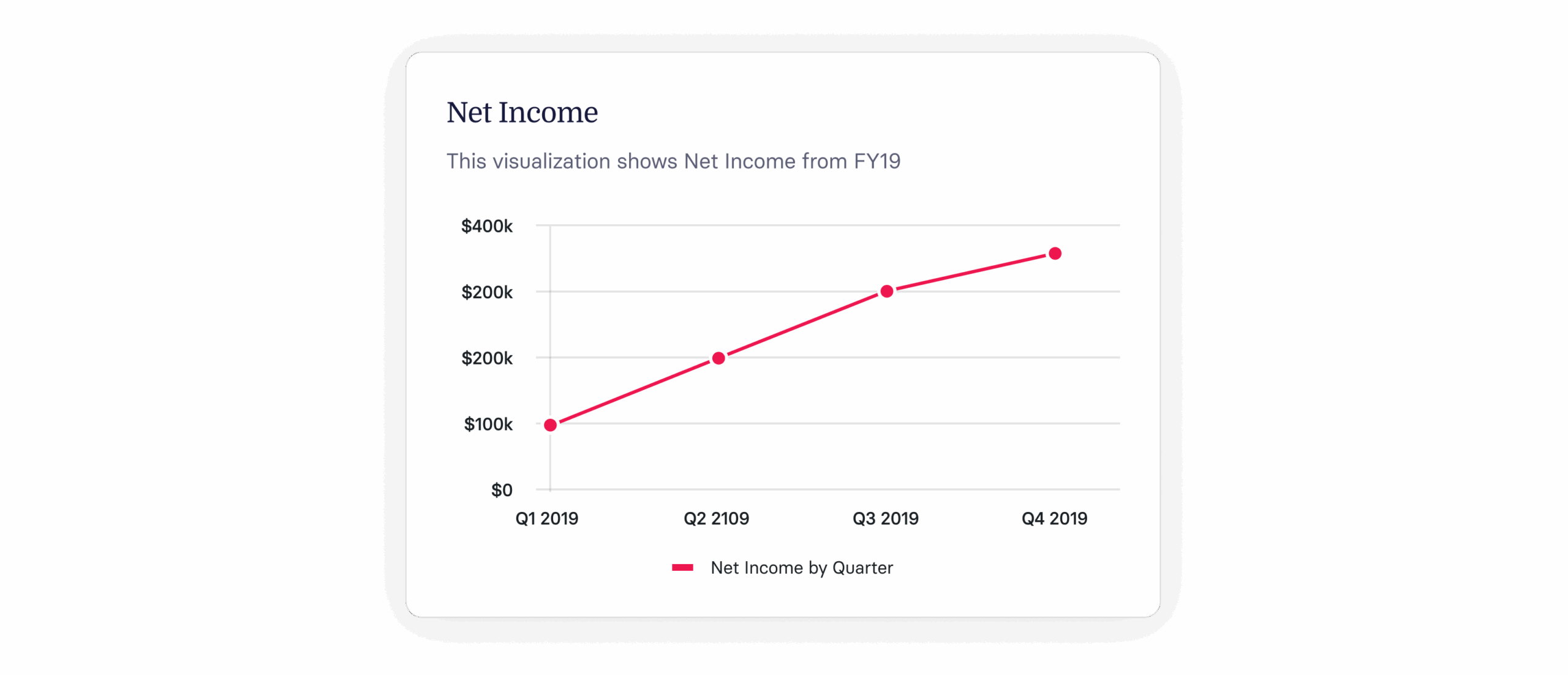
Key insights
- Net income is the profit a company retains after all expenses, taxes, and deductions, serving as a crucial indicator of financial health and profitability
- Calculating net income involves subtracting total expenses from total revenue, including costs such as interest and taxes
- Understanding net income helps businesses track profitability over time and inform growth plans
- Limitations of net income include non-cash expenses and accounting assumptions that can skew figures, requiring careful analysis alongside other financial statements
- Net income differs from gross income, EBITDA, and EBIT, which each measure profitability at a different point in the income statement
What is net income?
Net income is the profit that remains after a company subtracts all of its expenses, including operating costs, interest, taxes, and deductions, from its total revenue over a set reporting period. In simple terms, it shows whether the business made a profit or loss during that period.

How to calculate net income
The net income calculation involves taking total revenue and subtracting all expenses, including depreciation, amortization, and interest expenses.
Here’s the net income formula:
Net income = Total revenue – total expenses
If you want to break down formula further, it becomes:
- Net Income = [Revenue + Other Income] – Cost of Goods Sold (COGS) – Operating Expenses – Other Expenses – Interest – Taxes
Let’s use Netflix’s income statement as an example:
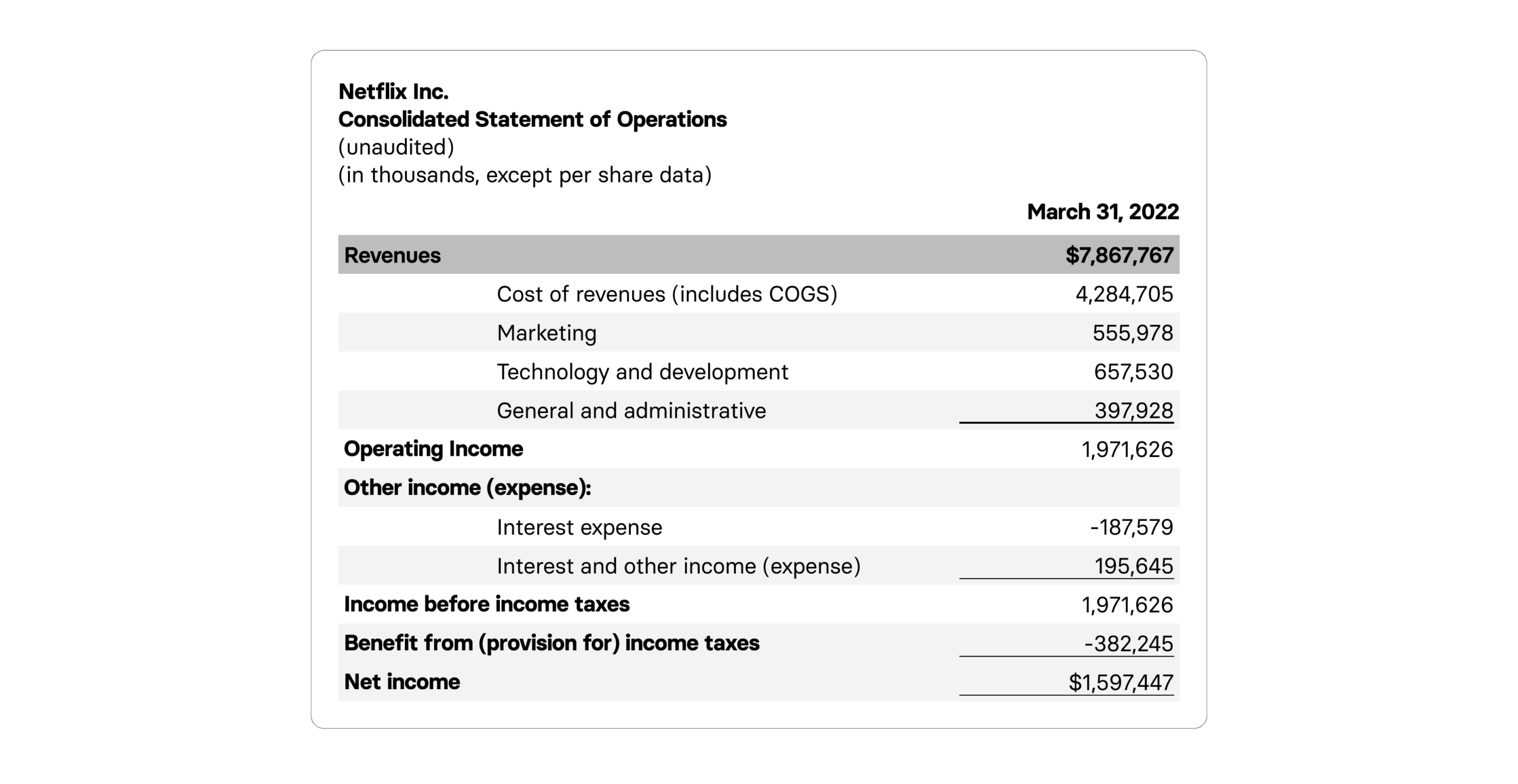
The statement starts with Netflix’s revenue for the quarter ended June 30, 2026: about $12.56 billion. It then subtracts the cost of revenues (Netflix’s version of COGS, which is mostly content costs) at about $6.04 billion, sales and marketing at about $824 million, administrative expenses at about $499 million, and technology and development at about $1.01 billion. That leaves operating income of about $4.19 billion.
Then you see other expenses and income, which in Netflix’s case is just interest: about $176 million of interest expense, offset in part by about $52 million of interest and other income. That leaves income before taxes of about $4.07 billion. Finally, the statement deducts about $667 million in income taxes.
The net income is the last line item in the company’s income statement. For this quarter, Netflix reported net income of about $3.40 billion, or roughly 27 percent of revenue. Comparing revenue with profit shows how much of what a company brings in actually reaches the bottom line.
3 reasons net income is important for a business
Net income (or net profit) is key to several decisions you make as a business. Here are some examples of net income’s importance:
1. Determine trends toward profitability
For VC-backed startups and high-growth businesses, turning a profit isn’t always the short-term goal. These companies often run at a net loss as they invest heavily in growth.
Still, tracking net income trends can help you understand if the business is moving toward profitability. Even in the early stages, those trends can signal whether your financial strategy is working.
2. Monitor financial health
Net income is a high-level view of financial health—especially important for public companies. If your net income is consistently low or negative, it could point to operational inefficiencies or overspending.
It also impacts other areas. For instance, a company that issues cumulative preference shares accrues a liability if it can’t pay dividends. Once profitability stabilizes, those unpaid dividends need to be addressed before equity shareholders receive payouts.
Accurate revenue forecasting makes it easier to identify challenges, manage costs, and protect net income.
3. Plan for growth
High-growth companies, especially in industries like SaaS, need capital to scale. Profits can be reinvested into the business through retained earnings, supporting everything from R&D to hiring.
Net income helps you understand how much you can retain and reinvest, giving your team more confidence in planning for the future.
Net income limitations: 3 things to be aware of
While net income is useful, it doesn’t tell the whole story. Here are three limitations to keep in mind:
1. Effect of accounting for non-cash expenses
Expenses like depreciation and amortization aren’t cash expenses. You don’t pay money for those expenses. While they play a valuable role in accounting, they often skew the net income figure.
This is especially true if the value of your assets decreases. For example, suppose your certified public accountant (CPA) recommends that you revalue your asset from $10,000 to $7,500. In that case, you’ll see a $2,500 expense on your income statement (and the asset’s value will reduce by the same amount on the balance sheet). However, you won’t pay that $2,500 to anyone.
In other words, non-cash expenses will decrease your net income but won’t affect your earnings outside the books.
2. Multiple assumptions
Net income can also be influenced by the assumptions used in financial reporting. Asset depreciation methods, for instance, can vary depending on business strategy.
A company may opt for aggressive depreciation to lower its tax burden—which reduces reported net income. Meanwhile, another business may use more conservative methods to present a stronger profit to potential investors.
These variations make it harder to compare net income across companies without digging into their accounting practices.
3. No fixed correlation with cash
A company may report $100,000 in net income, but that doesn’t mean it has $100,000 in cash. That’s because net income is calculated using accrual accounting, which records revenue and expenses when they’re earned or incurred, not when cash changes hands.
To understand actual cash flow, compare the income statement with the cash flow statement. The latter starts with net income and then adjusts for non-cash items and changes in working capital. For example, look at Netflix’s net income versus the cash flow:
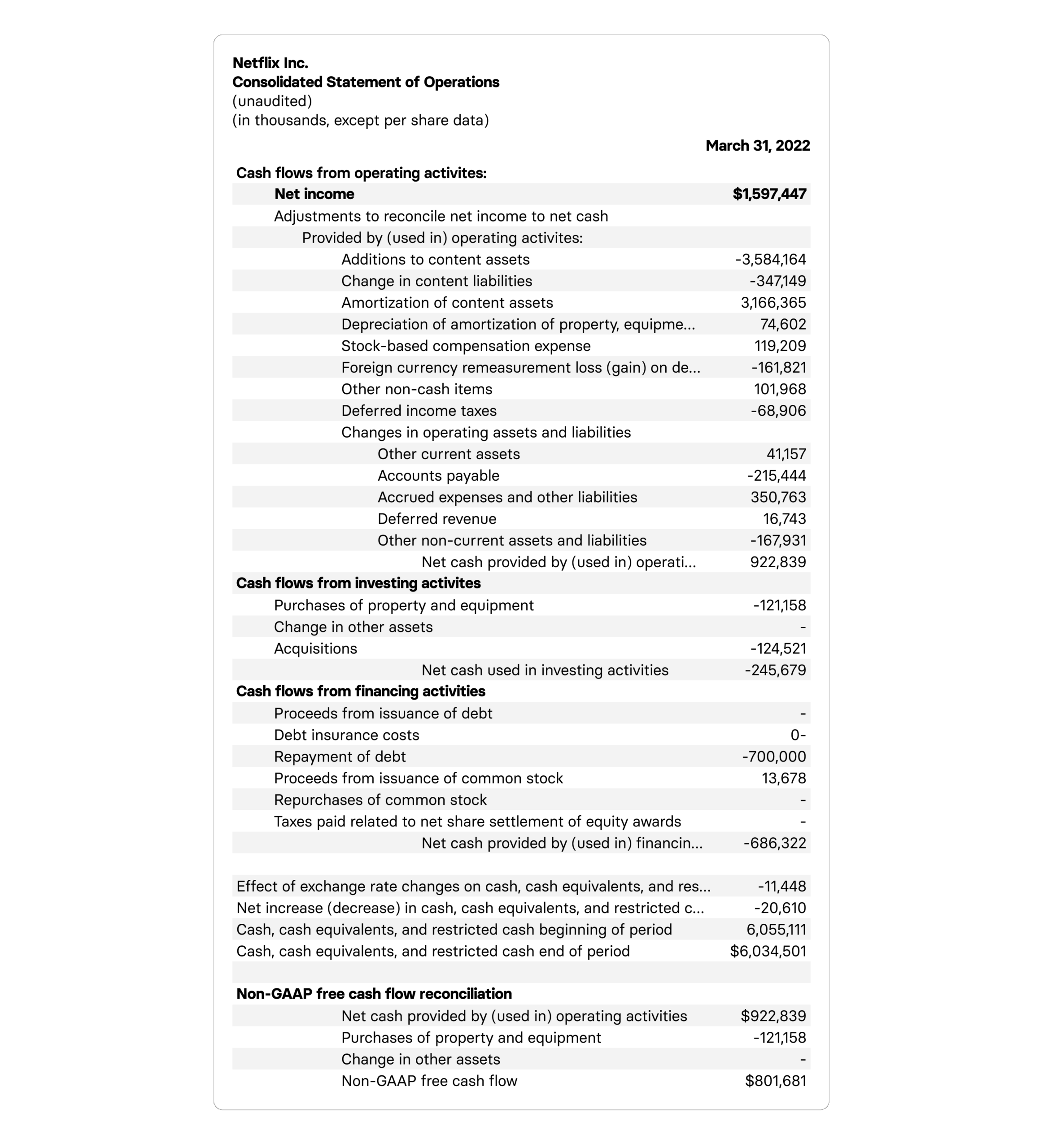
Notice how the cash flow starts with the net income.
The cash flow statement is essentially a reconciliation between the net income and the cash generated by the business.
Other financial terms commonly mistaken for net income
Net income is not the only type of profit that appears on the financial statements. You’ll see gross income, EBITDA, and EBIT as well. And if you’re looking at the tax books, you’ll also encounter taxable income.
Gross income
Gross income (or total income) appears at the beginning of the income statement. It’s what’s left after you subtract the direct cost of delivering your product or service from total revenue.

You can calculate the gross profit by deducting the direct costs of providing the service, such as server costs and payments to freelance software developers, from total revenue.
Gross profit is a measure of financial efficiency that helps you understand how effectively your company provides its services.
| Gross income | Net income | |
| Where it appears | Near the top of the income statement | At the bottom of the income statement |
| Costs deducted from revenue | Direct costs of delivering your product or service | All expenses, including operating costs, interest, and taxes |
| What it tells you | How profitable your core product or service is | How much profit the business keeps after all expenses |
Gross income and net income sit at opposite ends of the income statement. Between the two, net operating income reflects profit from a company’s core operations before interest and taxes, which is why it often gets confused with net income even though it stops short of the full picture.
Net profit margin
Net profit margin shows net income as a share of revenue. You calculate it by dividing net income by total revenue, then expressing the result as a percentage.
For example, a company with $400,000 in net income and $2,000,000 in revenue has a net profit margin of 20 percent.
Because it’s a ratio rather than a raw figure, net profit margin makes net income comparable across periods and across companies of different sizes. A rising margin signals that more of every dollar of revenue reaches the bottom line, even as the business scales.
EBITDA
EBITDA is an abbreviation for “earnings before interest, taxes, depreciation, and amortization.” It’s calculated as:

With EBITDA, you can see a company’s profitability without the effects of tax provisions, cost of financing, and capital expenditure.
The United States’ GAAP, SEC, and IRS don’t require companies to show EBITDA on their financial statements. But many companies include it anyway since it’s commonly used for the valuation of a company. For example, investors often use EV/EBITDA to compare companies and find promising investment options.
For SaaS valuation, investors typically rely on revenue multiples, so EBITDA isn’t as helpful in the context of SaaS companies.
EBIT
EBIT is an abbreviation for “earnings before interest and taxes.” It is calculated as:

EBIT helps you understand how efficient you’re at managing your business. For instance, if you’ve got a low EBIT but a high gross income, you’re spending too much on administrative expenses. And you need to look for alternatives.
Like EBITDA, companies don’t need to show EBIT on their financial statements.
However, many do share it since EBIT is also used for valuation. EV/EBIT is a common EBIT valuation metric.
Recommended For Further Reading
How your workforce shapes net income
Behind every line on the income statement are the people who do the work, and their compensation usually makes up the largest slice of operating expenses. That means the choices finance and HR leaders make about headcount, pay, and promotions move net income as directly as revenue does.
When those teams plan together with shared, current data, they protect the bottom line. HiBob’s recent report found that 82 percent of people managers say they would make more cost-effective decisions with timely, unified HR and finance data. The same report surveyed 4,700 people managers who made finance-related decisions, from adjusting pay to planning headcount and allocating promotions. It also found that 45 percent of HR leaders spend three to four hours assembling data from multiple systems before a performance review.
That’s time and insight finance and HR leaders can put back into planning. With HiBob’s Workforce Planning and Compensation features, teams can model headcount and compensation scenarios, connect workforce plans to financial planning outcomes, and see how each decision shapes net income before they commit. When people and numbers live in one place, HR and finance can steer profitability together with confidence.
Book a demo to see how HiBob helps your teams plan headcount and compensation with net income in view.
Net income FAQs
In business, net income is the final amount of remaining income a company has after all expenses, including taxes and payroll, have been deducted. Gross income, on the other hand, is the amount of total income before such expenses are deducted.
Net income for a business is the amount of income the business makes after tax expenses and other expenses are taken out.
Net operating income is calculated by subtracting only operating expenses from total income, while net income is calculated by subtracting all expenses (not just operating expenses) from total income.
Net income and net profit are interchangeable terms: they both refer to the amount of income or profit a business has available after all expenses have been deducted.